Claude Code Evaluation Harnesses Score Agent PRs and Diffs — But Harness Metrics Without Memory Retest the Same Edge Cases


An evaluation harness around Claude Code turns subjective "feels smart" judgments into repeatable benchmarks: fixed repos, golden tests, diff review rubrics, and regression gates before merge. Platform engineers wire harnesses into GitHub Actions or Jenkins so every agent change produces comparable scores — essential once more than one model or prompt variant ships weekly. The limitation that keeps showing up in production is not model capability — it is memory.
Harnesses excel at *measuring this run*; they rarely *remember why* last month's baseline shifted or which flaky test correlated with a real outage.
Platform metrics usually flip in predictable ways once Claude lands in a real org: pull requests merge faster, support macros handle more tier-one questions, and incident bridges spend less time re-explaining architecture. Those wins are real. They also hide a second curve — coordination cost across squads — that only appears when multiple agents, dashboards, and humans all need the same ground truth about customers, services, and policy exceptions.
Within six to twelve months, engineering directors describe the bottleneck shifting from "smarter models" to "knowledge plumbing." That is where episodic chat, static config, and one-off spreadsheets stop scaling. A deliberate AI agent memory tier becomes the difference between repeating discovery and compounding it.
None of this diminishes what Anthropic ships: capable models, thoughtful safety defaults, and APIs that meet production expectations. It simply clarifies the division of labor — models reason; memory systems retain — so teams stop blaming "hallucinations" for what is often missing ground truth.
Claude Code: What Teams Get Right (And What Still Breaks)
Leaders adopt these patterns because they reduce variance: fewer surprise behaviors, faster reviews, clearer ownership of prompts and tools. The developer experience improves measurably when agents stop rediscovering the same repository trivia every Monday.
Security and compliance teams appreciate explicit boundaries: what tools an agent may call, which subnets it may reach, and how prompts are versioned. Product teams appreciate faster iteration on UX. None of that removes the need for durable recall when the same customer story spans sales, support, and engineering — each with its own Claude deployment.
Yet when the same teams scale to dozens of agents, environments, and compliance zones, they hit coordination debt. Information discovered in one workflow rarely becomes a first-class object another API can query. That gap is structural: conversation and config files are not a substitute for a MemU Agentic Memory Framework-style layer that stores entities, relationships, and outcomes with retrieval tuned for agents.
What Claude Code Does With Memory Today
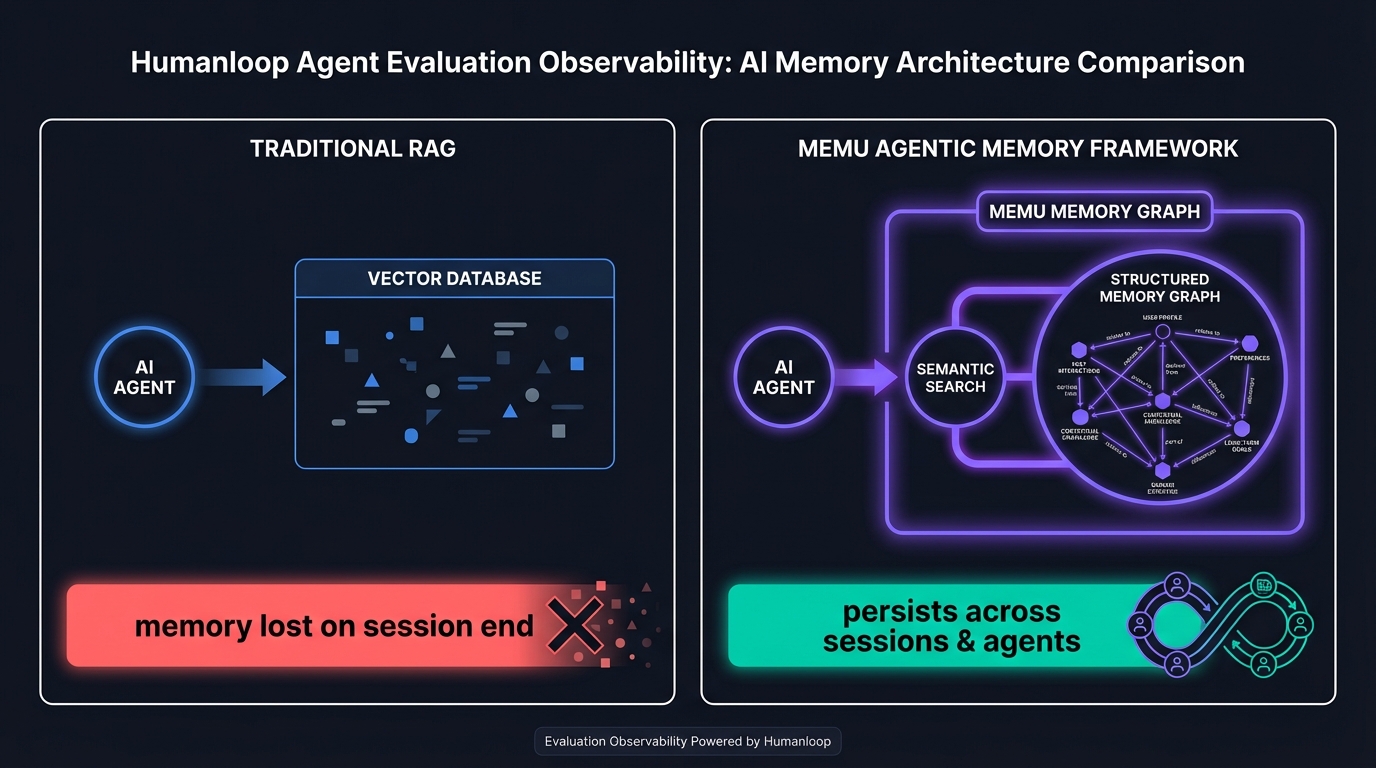
Typical harness setups reset environment state per job. They capture logs and numeric scores in CI artifacts, then age out of retention. Other coding agents — OpenHands, Devin-style runners, IDE agents — follow the same pattern: strong comparability inside the pipeline, weak longitudinal memory outside it. Spreadsheet exports and wiki post-mortems are manual patches, not agent-queryable stores.
Teams sometimes respond by enlarging context windows, adding more RAG chunks, or copying transcripts into wikis. Each patch helps a slice of users but increases cost, latency, or manual labor. None of them gives you relationship-centric recall — who approved an exception, which dependency version correlated with a failure, or how two tickets about the same account were actually one root cause.
**"A harness proves correctness snapshots; it does not compound institutional debugging knowledge unless you add memory."**
That is a category-wide pattern for frontier assistants — not a single vendor oversight. The fix is architectural: separate the loop that thinks from the store that remembers, then wire them with APIs agents already know how to call.
The MemU Agentic Memory Framework: A Different Architecture
The MemU Agentic Memory Framework integrates through HTTP APIs and SDKs so Claude-based stacks keep their existing routers, guardrails, and deployment patterns. You add retrieval calls where tool results would otherwise disappear — after merges, after incidents, after customer conversations. A team runs nightly harness jobs against fifty microservices. Scores drift slowly when upstream APIs change; without memory, investigators grep old CI logs every time instead of asking an agent what changed between green builds.
Differentiation comes from dual-mode retrieval: semantic search for fuzzy questions plus a structured memory graph for ownership, dependencies, and causality. Memories persist across sessions and can be shared across agents where policy allows, which matters when more than one automated worker touches the same customer or service. At scale, graph-aware recall typically outperforms dumping ever-longer transcripts into the context window.
Integration work stays bounded: most teams add memory writes at completion boundaries — PR merged, ticket closed, incident resolved — and memory reads at planning boundaries — new task, new session, new on-call rotation. That rhythm mirrors how humans debrief without forcing every token through a new database in real time.
Agents need fast loops and durable facts. The MemU Agentic Memory Framework is the substrate that keeps conclusions addressable after the chat ends — without pretending every token belongs in prompt caching or static markdown.
Head-to-Head: MemU vs. Claude Code-Centric Stacks
Harness without MemU: Deterministic gates, reproducible tasks, clear pass or fail. Limited machine-readable link between failures across weeks.
Harness plus MemU: Failed cases, root-cause notes, and dependency fingerprints persist for semantic and graph retrieval.
Compared with homegrown vector-only stores, MemU emphasizes relationships and provenance — fewer "similar but wrong" retrievals when multiple entities share overlapping language. Compared with doing nothing, it is the difference between repeating work and compounding it.
Latency-sensitive agents still win: you retrieve a small set of grounded memories instead of replaying entire threads. Precision-sensitive teams win: you attach citations and timestamps to memories for audit. Neither outcome requires ripping out Claude — it requires treating memory as its own service, the way you already treat auth and billing.
Empowering Claude Code: Better Together
MemU does not replace your Claude stack; it makes that stack remember responsibly.
- Regression triage: Agents query past failures matching the same stack trace signature.
- Benchmark evolution: Memory anchors which prompt version fixed which harness task cluster.
- Org-wide learning: Cross-repo harness insights aggregate instead of siloing per pipeline.
Memory infrastructure can run with high availability so agents in always-on pipelines retrieve consistently — the same reliability bar teams already expect from observability and CI, applied to recall.
Postponing a memory layer often produces "smart but expensive" agents: they re-read the same files, re-query the same APIs, and re-summarize the same documents because no durable index captures prior conclusions. The cumulative token and labor cost usually exceeds the engineering time to wire structured writes at task boundaries. Treating memory as infrastructure — like metrics and feature flags — keeps Claude deployments economical as they grow.
Get Started with MemU
Pair Anthropic Claude with the MemU Agentic Memory Framework when your agents need cross-session, cross-team facts — not just longer prompts. Visit memu.pro to explore the API, or the GitHub repository to integrate memory into your existing agent code.
Tags: Claude Code, evaluation harness, AI coding agents, agent memory, CI automation, MemU AI, Anthropic