Turn Agent History into Reusable Skills
Useful workflows compound instead of disappearing when a session ends.
A scheduled bridge captures new agent sessions and prepares self-contained jobs. The host agent reviews related skills and decides whether to do nothing, improve an existing skill, or create a new one. memU commits and indexes the resulting Markdown for future tasks.
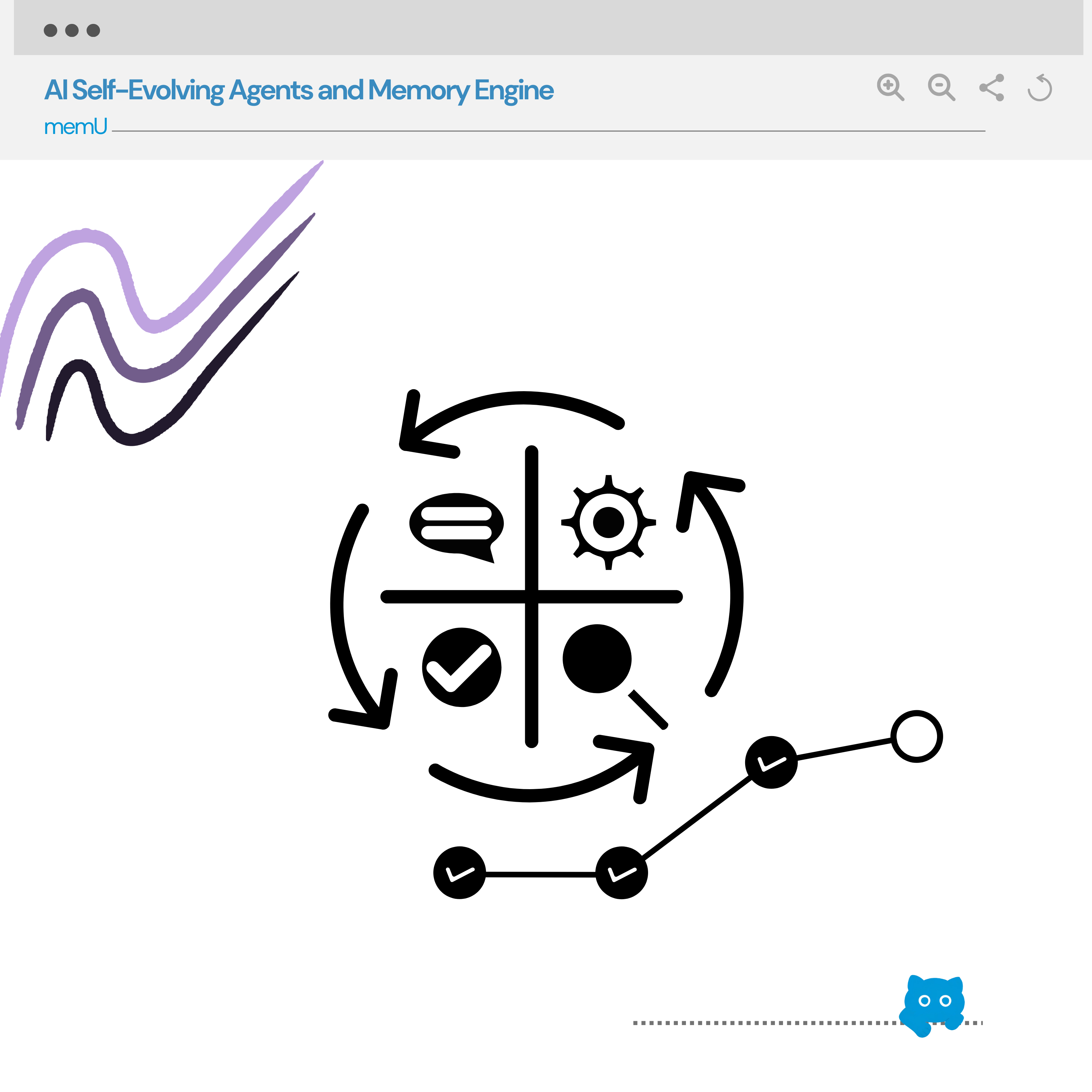
What Actually Evolves
The reusable skill library grows through the work of the host agent. The memU service does not independently reason, predict, or reorganize memory.
How Automatic Skill Extraction Works
Skills That Compound Well
Guardrails by Design
Ready to Unlock the Full Potential of AI Memory?
Store readable memory and skill files with searchable segments in a shared Cloud, SQLite, or Postgres backend.
Explore Memory StorageEmbed a query once, rank relevant file segments and workspace resources, then return the complete readable files to the agent.
Explore Memory RetrievalLet the agent turn useful session history into reusable Markdown skills, then index those skills for future tasks.
Now HereConnect multiple host adapters to one configured backend so skills learned in one agent can be retrieved by another.
Explore Cross-Agent MemoryKeep judgment and synthesis inside the agent while memU handles durable storage, embeddings, and retrieval.
Explore Agent-Driven MemoryGive agents inspectable memory and skill files instead of hiding all useful context inside opaque vector records.
Explore Markdown MemoryCapture coding sessions and compound successful workflows, debugging lessons, and project conventions into reusable skills.
Explore Coding SkillsInspect the lightweight Python implementation, run locally, and adapt host integrations for the agents you already use.
Explore Open SourceConnect Your Agents to memU
Get a memU Cloud key, then give the installation prompt to your agent. The skill configures its host adapter against one managed, cross-device memory backend.
Get the Install PromptAsk your agent to follow the open-source SKILL.md. It installs the CLI, configures SQLite or Postgres and an embedding provider, then verifies retrieval with the host adapter.
View SKILL.mdRun the installation skill in each additional host. Every configured adapter can record its own sessions and retrieve from the same shared backend.
See Host AdaptersFAQ
memU is a lightweight, agent-driven memory system for the agents you already use. It gives connected agents one shared, inspectable memory layer across sessions, agents, and devices.
The memU installation skill configures a host adapter for your agent. A scheduled task captures new session history, the agent decides what memory or skill Markdown to write, and the adapter retrieves relevant files before future tasks. Users do not need to integrate a public memory API.
No. memU's memory service makes no LLM or chat calls. Judgment and synthesis remain inside the host agent; memU stores the Markdown it prepared, creates embeddings, and retrieves relevant files.
The query is embedded once. memU ranks searchable file segments and workspace resources by vector similarity, rolls matching segments up to their complete recall files, and returns segments, files, and resources without an LLM in the retrieval path.
memU includes dedicated adapters for Codex, Claude Code, Cursor, OpenClaw, Hermes, and WorkBuddy. A generic adapter can detect compatible session logs and instruction files for other agents.
Yes. The self-hosted mode supports SQLite for local use and Postgres with pgvector for larger or concurrent stores. Local mode requires a configured embedding provider. memU Cloud provides a managed, cross-device backend.
Yes. The Python package, CLI, host adapters, and core memory service are available on GitHub under the Apache-2.0 license.
Make Successful Agent Work Reusable
Install the scheduled bridge and let your existing agent grow an inspectable library of skills from real outcomes.